
Trusted Foundation Repair of Arizona
Trusted Foundation Repair of Arizona
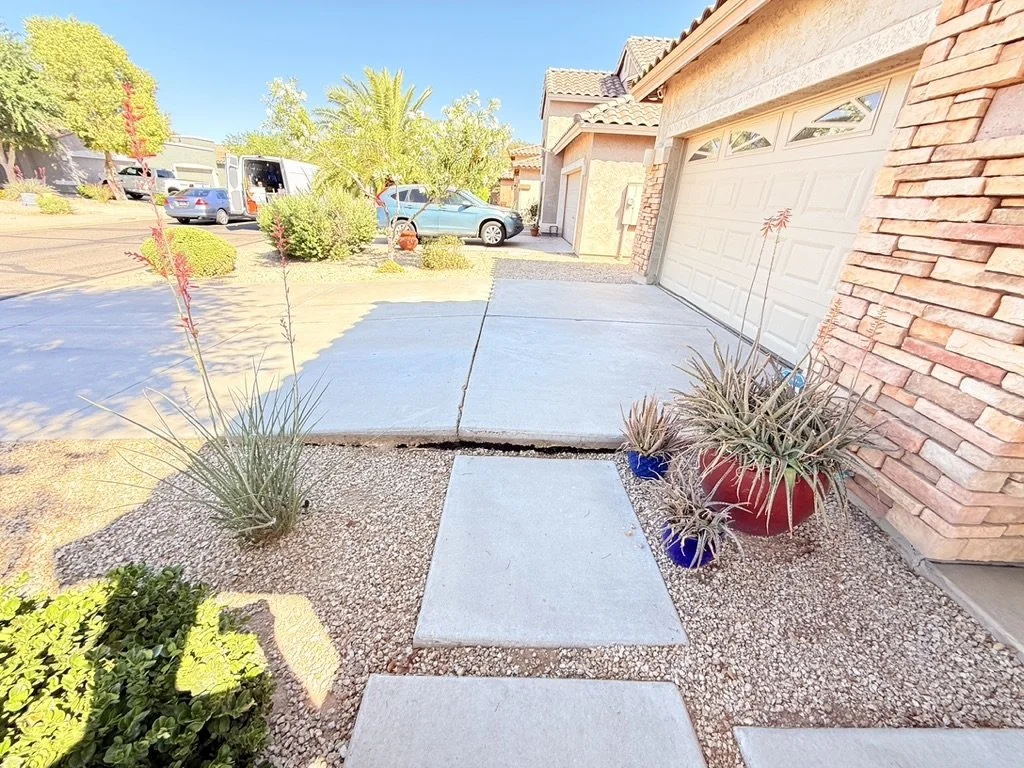
The Hidden Danger Under Your Concrete
When soil beneath a concrete slab erodes or settles unevenly, it can leave an empty space — a void —between the bottom of the slab and the ground below. From the surface, everything looks fine. But that hollow space means your slab is unsupported, and it’s only a matter of time before it cracks, sinks, or collapses under load.
Void filling is the process of injecting material beneath a concrete slab to fill those empty spaces, restore full support, and prevent the slab from failing. At Trusted Foundation Repair of Arizona, we use high-density polyurethane foam to fill voids quickly, precisely, and with minimal disruption to your property.
What Causes Voids to Form Under Concrete in Arizona?
Soil Erosion: monsoon rains can wash fine soil particles out from under slabs, especially where drainage flows under or alongside concrete
Shrink-swell soil cycles: Arizona’s expansive clay soils pull away from the underside of slabs during dry months, creating gaps
Plumbing and irrigation leaks: slow leaks beneath a slab carry soil away particle by particle over months or years
Rodent activity: in desert areas, burrowing animals can create surprisingly large voids under slabs
Settlement after construction: improperly compacted fill soil consolidates over time, leaving gaps between the slab and the ground
Voids under a driveway or garage floor are especially serious. The weight of a vehicle on an unsupported slab can cause sudden cracking or collapse. Don’t ignore hollow-sounding concrete.
How We Fill Voids Under Concrete
Inspection: We assess the affected area, probe for soft spots, and use our experience to identify the extent of the void.
Drill Small Ports: We drill penny-sized holes through the slab at strategic locations above the void.
Inject Expanding Foam: High-density, two-component polyurethane foam is injected through the ports. As it expands, it fills the entire void cavity and bonds to the slab above and the soil below.
Monitor and Adjust: We watch for foam emergence at nearby ports to confirm complete void fill and adjust injection as needed.
Patch Ports: The small drill holes are patched flush with the slab surface.
Surface-Ready: The area is typically ready for foot traffic in 15 minutes and vehicle traffic within 30–60 minutes.
Frequently Asked Questions - Void Filling Under Concrete
Q: How do I know how large the void under my slab is?
A: The size of a void is often hard to gauge from the surface. Small, localized voids might be just a few cubic feet. We probe and assess during the inspection to get a sense of the scope before recommending an approach.
Q: Will foam void filling crack my slab?
A: No. Our injection process is controlled precisely. We monitor the expansion and adjust the injection rate to ensure the foam fills the void without over-pressurizing the slab.
Q: Is void filling just a temporary fix?
A: No. If the source of the void-forming erosion is addressed (drainage correction, plumbing repair), void filling with polyurethane foam is a permanent solution. The foam is non-compressible and won’t break down. If the underlying cause (e.g., an ongoing plumbing leak) isn’t fixed, new voids may eventually form.
Q: How quickly can you schedule void filling?
A: We typically schedule within a few days to a week of your estimate. Void filling is a time-sensitive repair, however. The longer a void remains, the larger it can grow and the greater the risk of slab damage.